echoarchive
Conversational Civic Tech for Historical & Emotional Reflection
My Role
UX Researcher
UX & Interaction Designer
Engineer
Facilitator
Tools
Figma + MCP, Cursor, HTML, CSS, JavaScript, Claude
Responsibilities
Performed extensive secondary & primary research, facilitated co-design sessions, iterated on designs, built prototype through Figma's MCP server

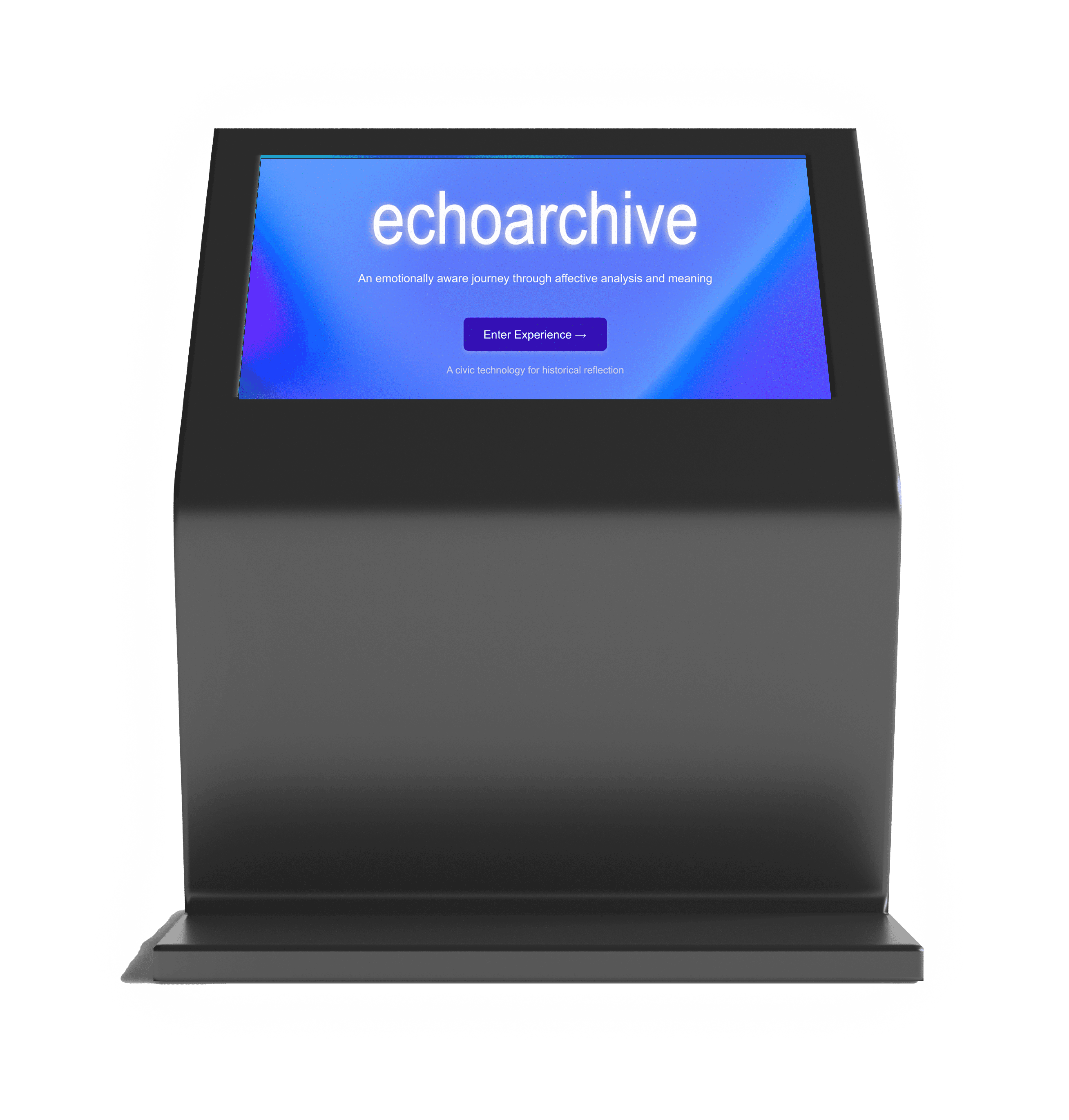
about
The design problem

In 2025, conversations around historical erasure, public memory, and state-controlled narratives became increasingly visible in civic discourse.
"Restoring Truth and Sanity to American History” and "Divisive Race-Centered Ideology"
Executive Order 14253
Presidential signature
opportunity Space and goals
I began wondering . . .
Could conversational systems preserve collective memory?
Inspired by these conversations surrounding Executive Order 14253 and broader anxieties around historical revisionism, I explored how conversational systems might preserve emotional memory inside civic spaces.
I used Google's Conversational Fit Quiz to determine whether conversation design is the right strategy for this product:
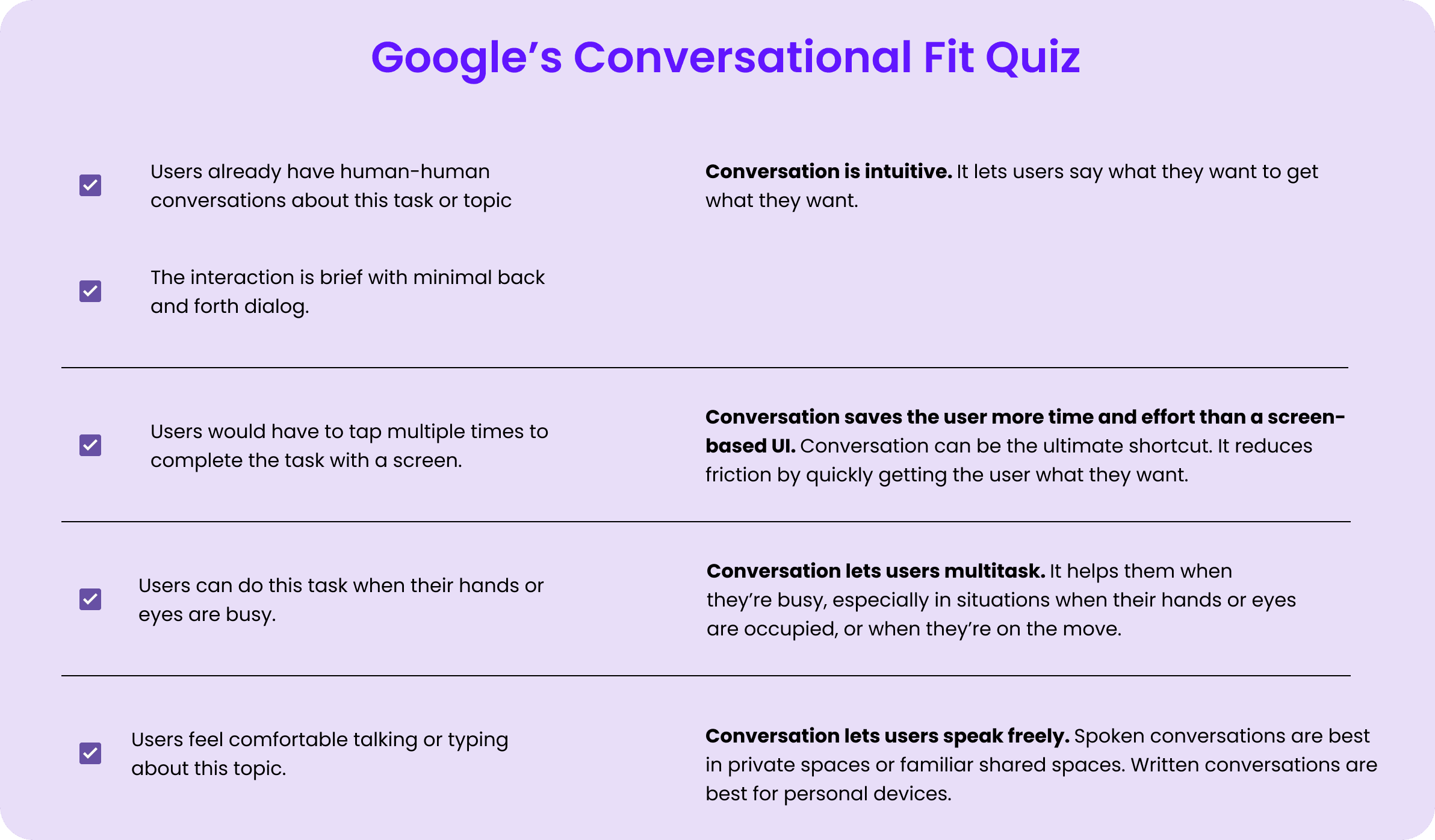
Museums and exhibitions already bring up profound dialogue about history and culture. Visitors quietly negotiate grief, discomfort, identity, anger, and reflection as they move through exhibits.
After confirming that a conversational bot is the right direction, I began to lay out some goals for this product:
1
Invite emotional reflection on historical exhibits and foster dialogue
2
Preserve emotional memory and resist narrative and historical erasure.
Outlining Design Canvas
I then defined conversational principles
Once I had major goals outlined, I began to define the following:
User Intents
Potential Utterances
Conversational States
Slots
Example Script
User intents
I laid out the following User Intents:
Reflect
Connect
Decompress
Share
These are the main actions I thought a user would be interacting with the product for. Namely, reflecting on a museum exhibition, connecting with community, decompressing or any other output after bot recommendation, and sharing their reflection online through a forum.
Potential utterances
The user might achieve said intents and goals through some of these example utterances:
I’d like to share my thoughts
I want to connect with others
Connect
I want to stay private
I want to share my thoughts to the community forum
I want to remember this moment
I’d like to record my thoughts before I forget them
Can I see what other visitors felt about this exhibit?
Discussion space
Join discussion space
I want to connect with the community around this topic
Voice share
Text share
Video share
Coversational States
Given these varied utterances and the many ways a user may interact with different elements, I also needed to define these state changes through visual and functional transitions:
greeting → prompt → listening → interpreting → offering_paths → deepening → closure
Having these different potential stated defined helped me to them write out an example script between the bot and the user.
Research and theories
Early concepts and iterations
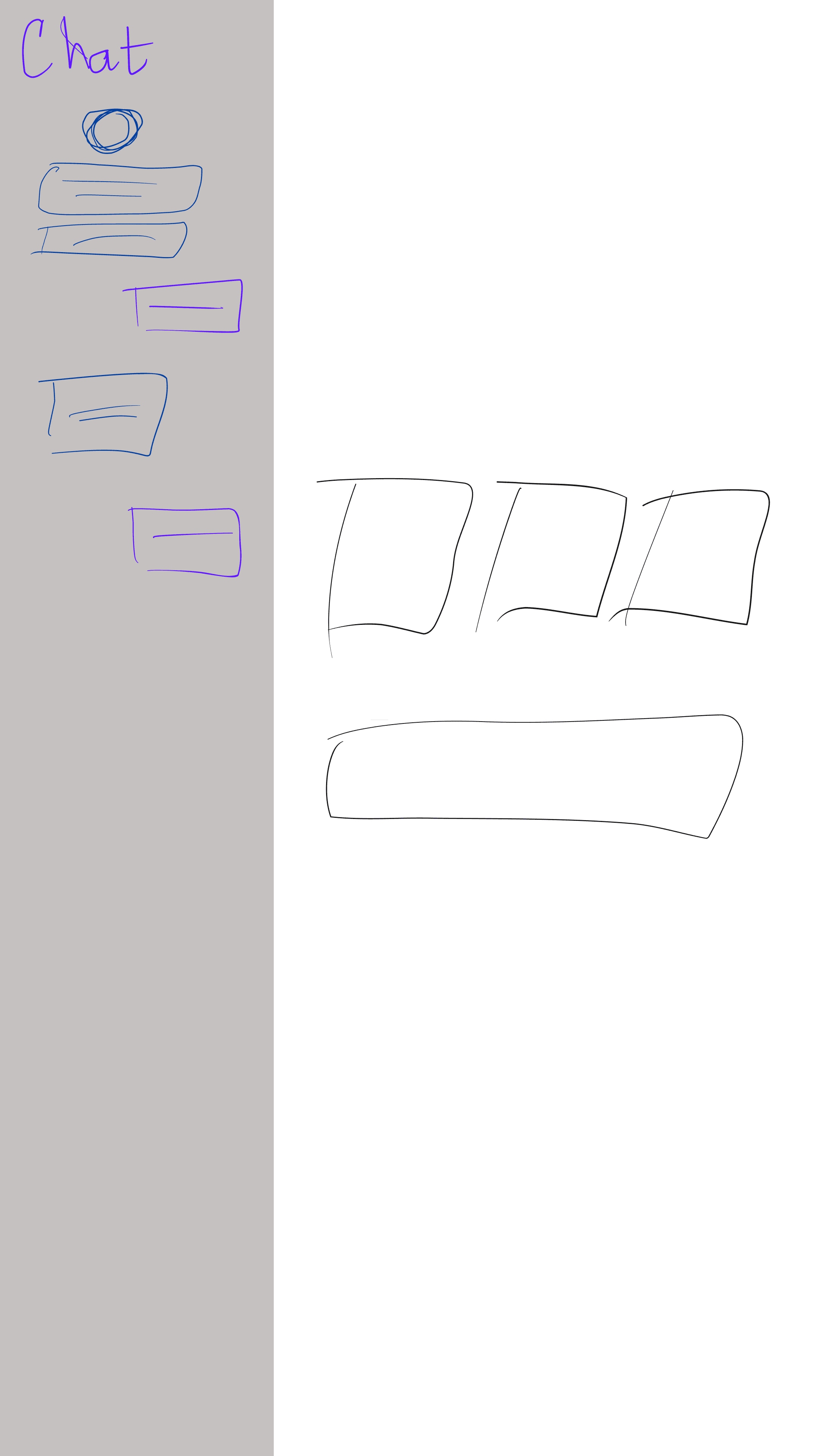
The next stage was to convey a storyboard and initial mockups to potential users as a part of feedback and co-designing sessions.
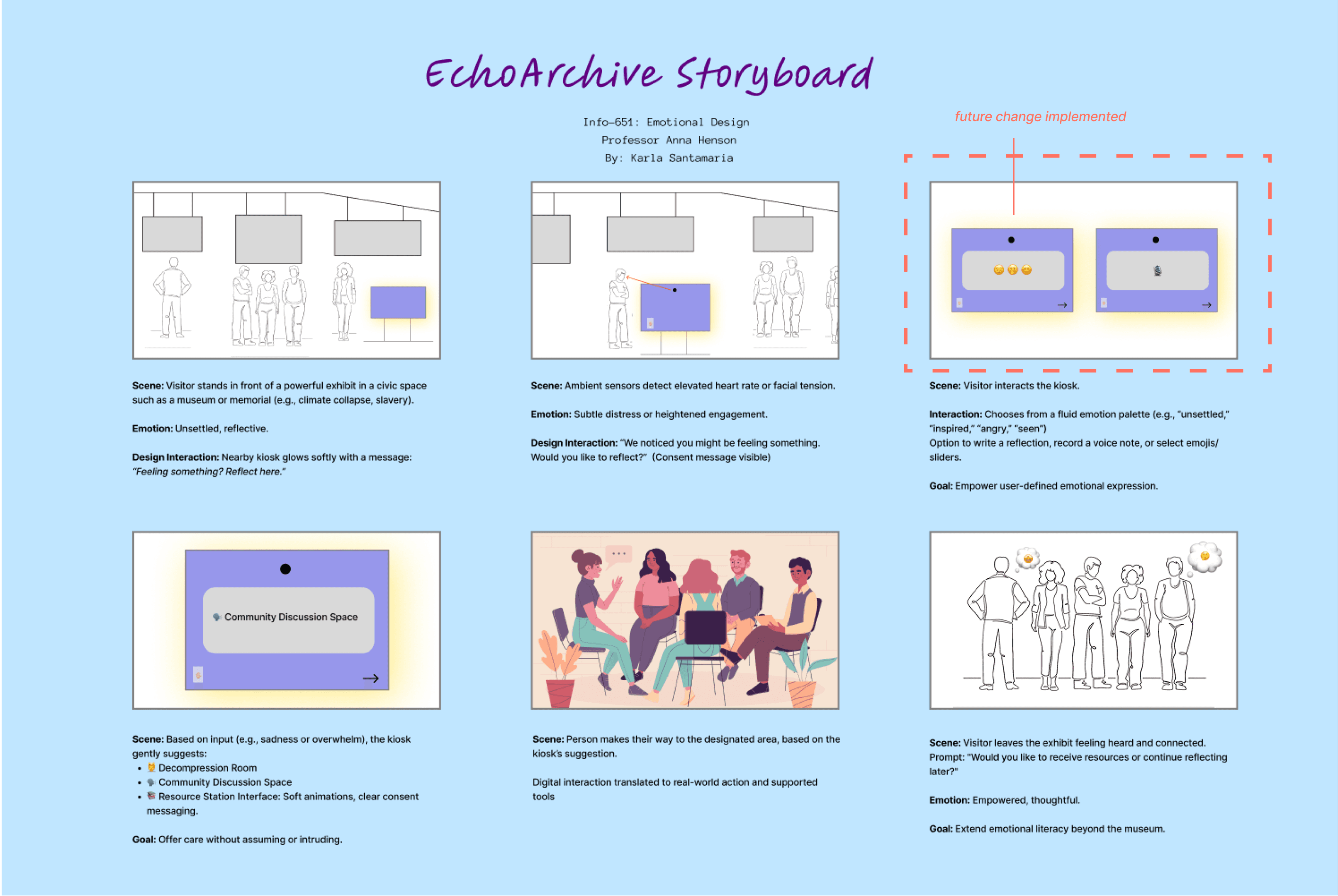
Early testing, along with several theorists who have contributed to the field of HCI, UX, ethics, emotion, culture, and psychology shaped my process and design decisions.
“Emojis can be interpreted differently depending on the context.”
–interview response
“I would like to know that my identity is safe. That it won’t be public.”
–interview response
“It would be cool if there was a way to connect with the community afterwards.”
–interview response
Early testing, along with several theorists who have contributed to the field of HCI, UX, ethics, emotion, culture, and psychology shaped my process and design decisions.
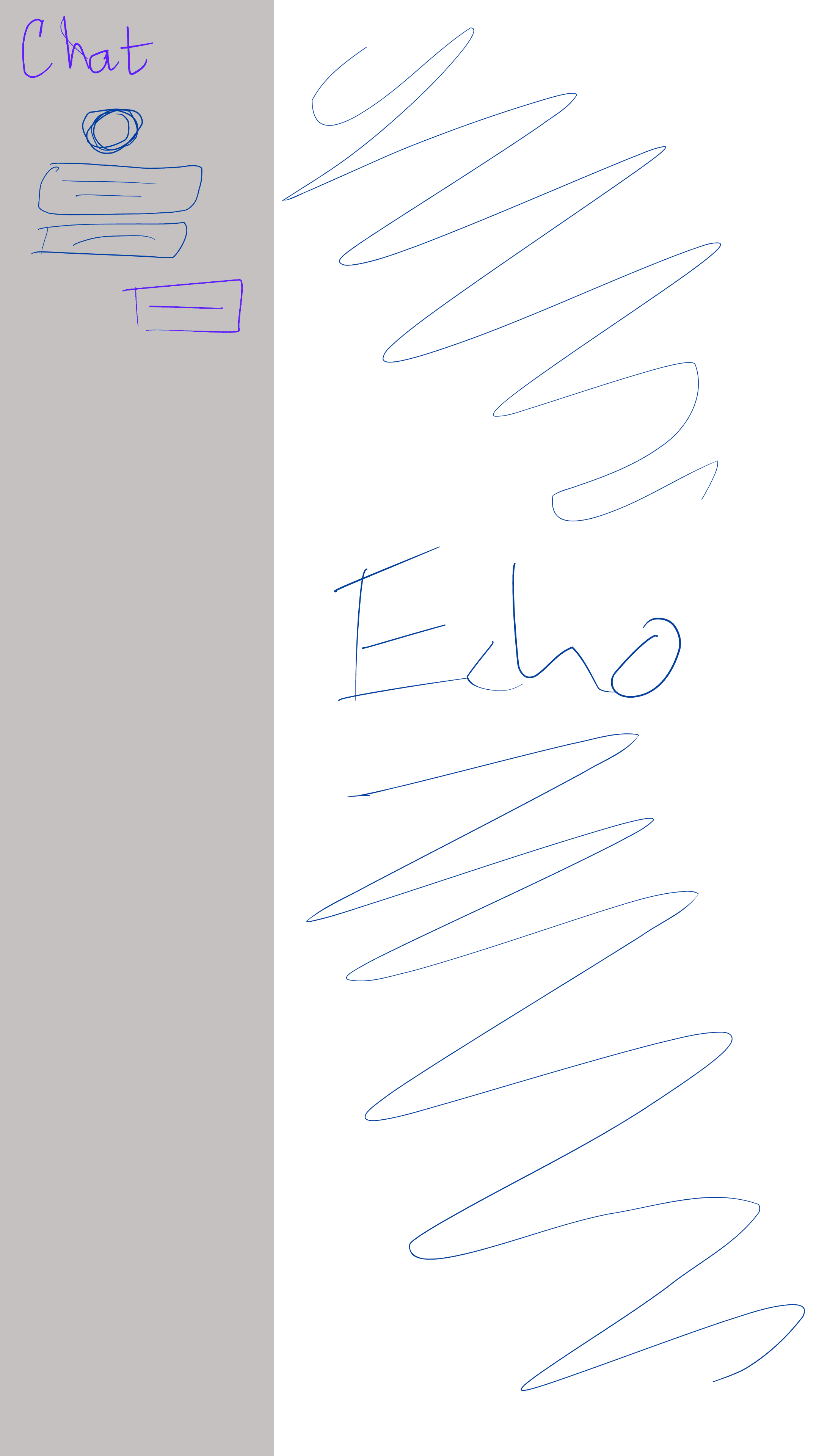
Initial Sketches


Mid-fi Mockups Post User-Testing
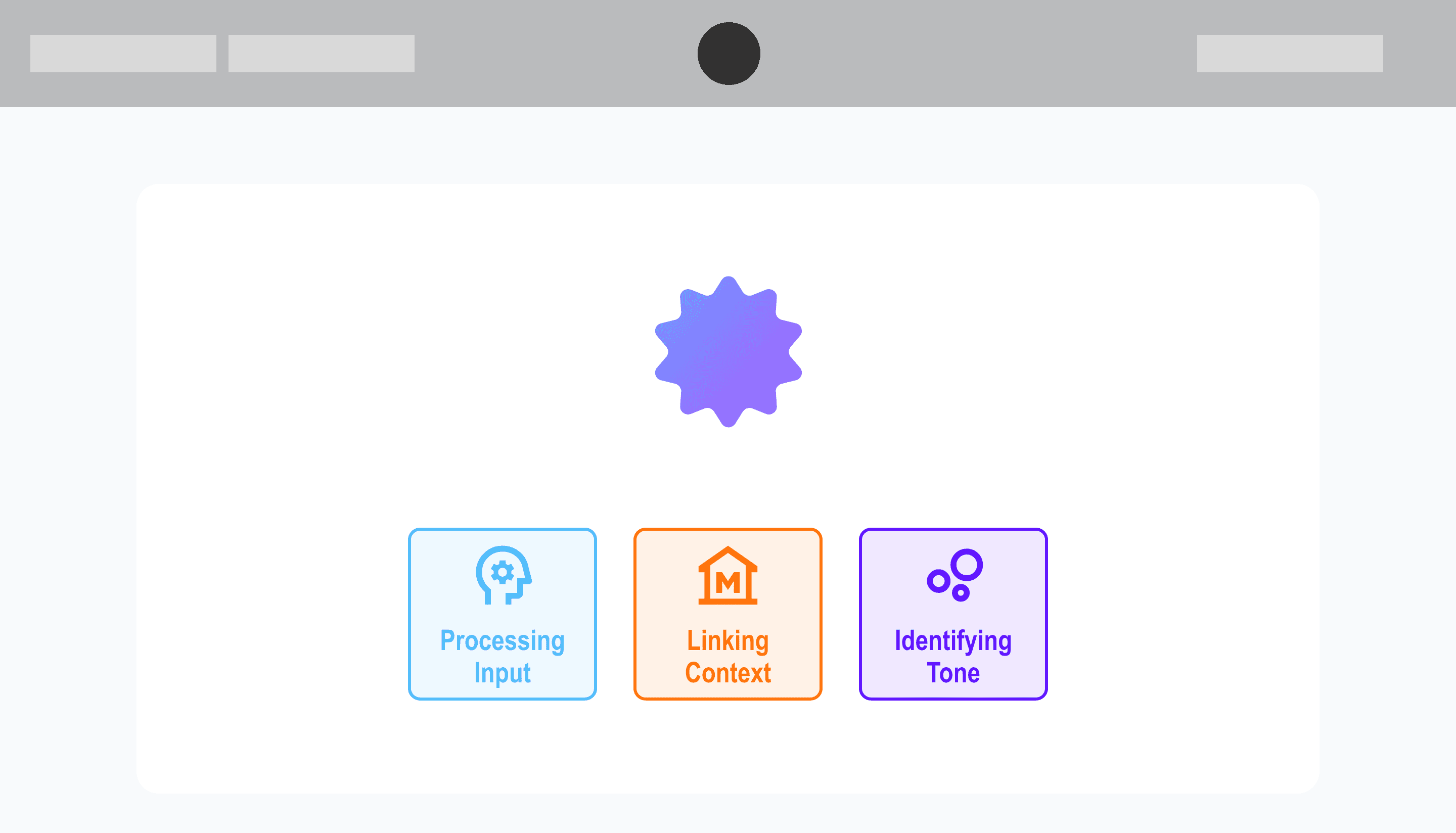
Processing
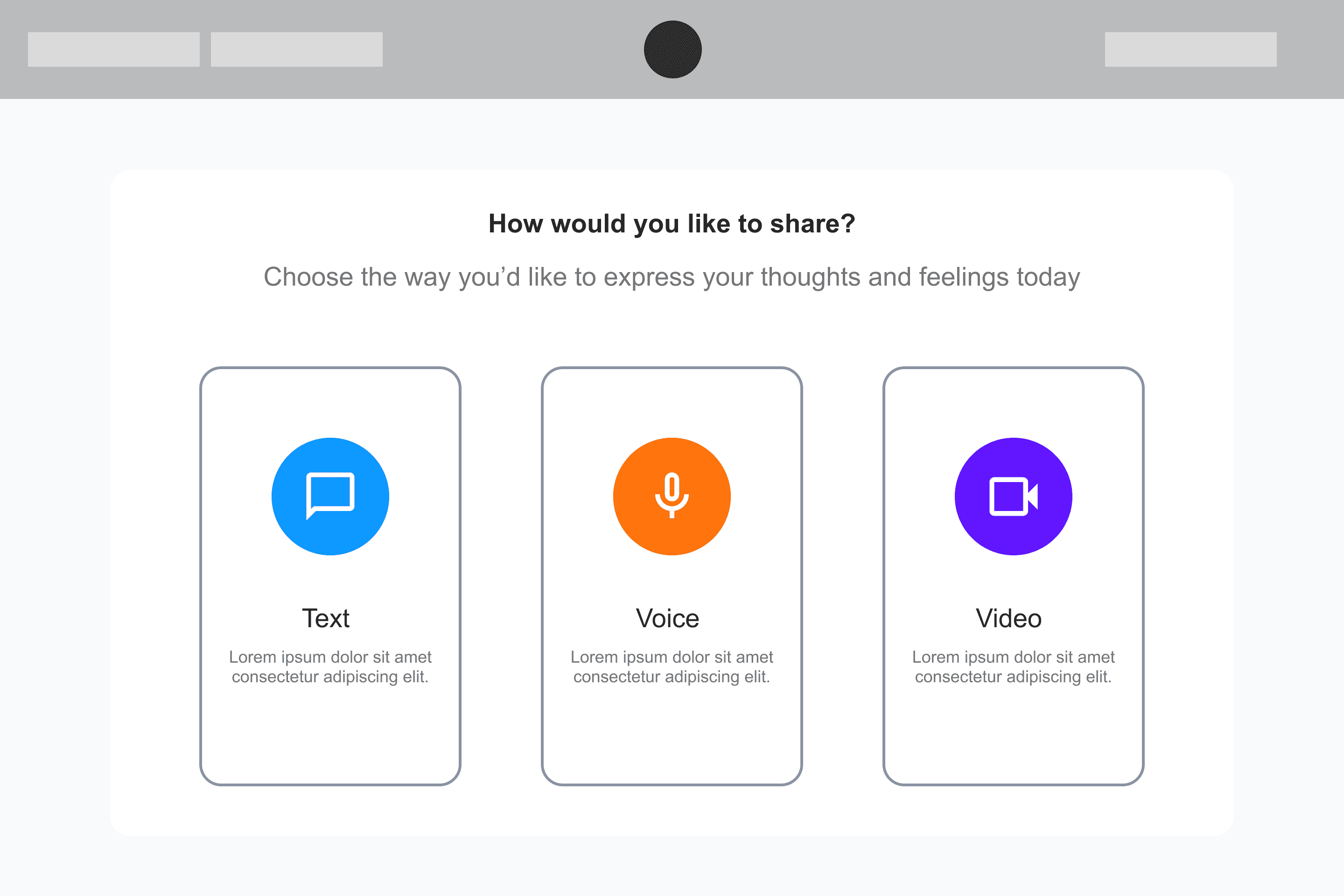
Sharing
1.
Onboarding
3.
4.
Offering Paths
2.
Echo as a facilitator: Sherry Turkle
When I came up with the idea of implementing an avatar to guide the user through the process, I created an Ethical Impact Checklist to make sure I could design for emotion without exploitation.
According to Sherry Turkle in Alone Together, this creates a risk of "illusionary empathy." To mitigate this risk, "Echo" the avatar would be explicitly used as a mere facilitator and let the user know its capabilities upfront.
Note: Designing Echo's Personality
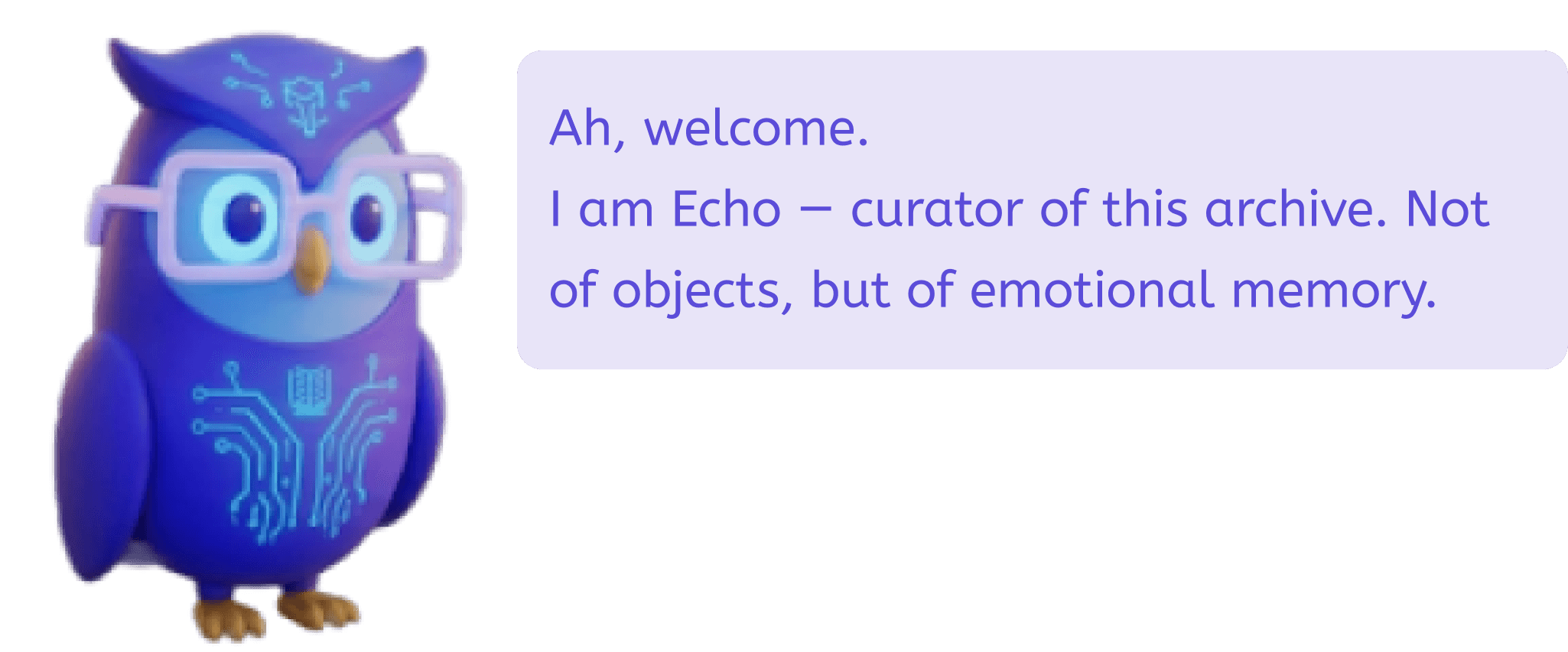
I used a LLM framework to design echo's personality and tone as such:
A scholarly curator who finds human emotional experience as worthy of careful preservation as any artifact. Slightly formal, never cold. Occasionally verbose, then catches himself. Deeply sincere.
Emotional extraction: Crawford vs barrett
In early iterations of echoarchive, users were prompted to select their emotional state to the closest matching emoji. This is rooted in Crawford's traditional view of emotions as reactive processes triggered by external events, whereas Barrett's Theory of Constructed Emotions argues that emotions are predications created by the brain to make sense of bodily and environmental inputs.
Barrett's theory challenges the notion of emotions as fixed, universal states encoded within our neural architecture, emphasizing that our emotions are dynamic constructs shaped by our individual histories, cultural contexts, language and social interactions.
Crawford: Classified Emotions
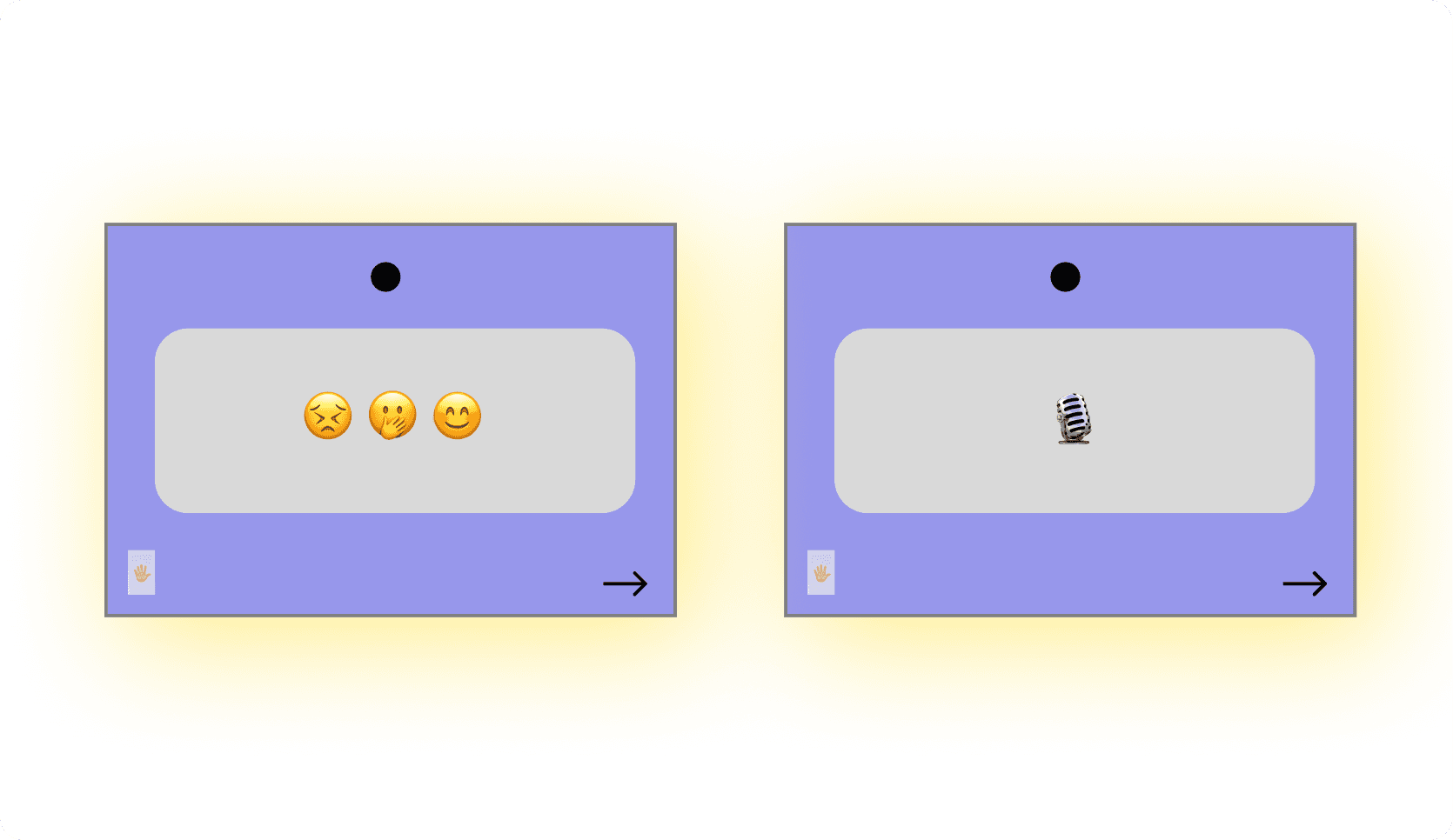
Barrett: Constructed Emotions
Emotion-aware system: Rosalind Picard
echoarchive takes influence from Rosalind Picard's extensive research in affective computing that has lead to systems that can detect, interpret, and respond to human emotions.
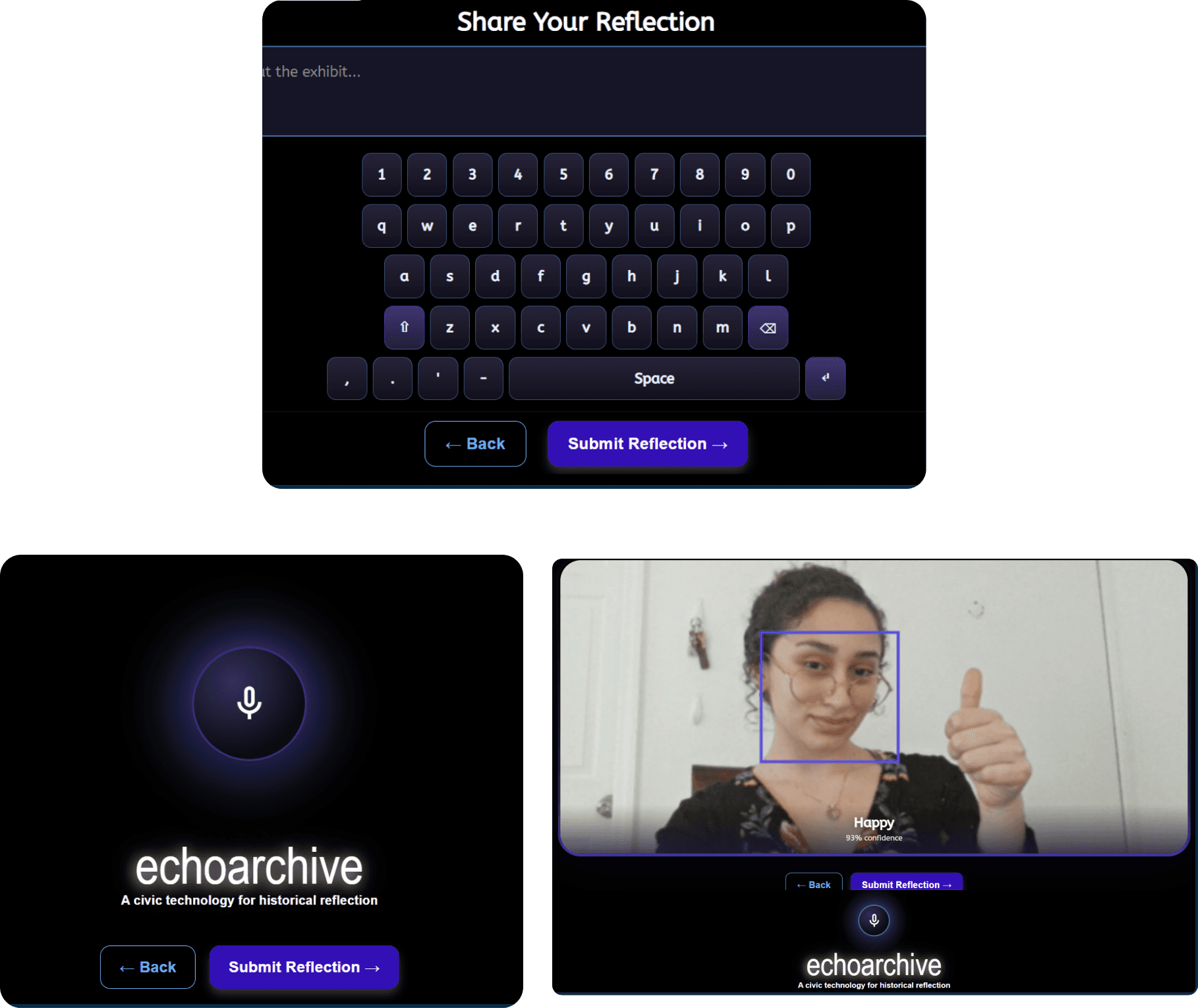
I used 3 main channels where Picard's work has been influential in creating AI that can pull affective signals. Namely, text, voice and face, in which I implemented an API for Facial-Emotion Recognition into the system:
Multi-modal approach
Design Justice: Costanza-chock
Through co-design sessions with users who would be affected by Executive Order 14253 and who would interact with this kind of product, I made sure to center what they wanted out of such a tool, emphasizing privacy protections and community connection.
Through this, I made sure to have an option to create a profile to join an online forum given detailed consent and connect further with their communities.
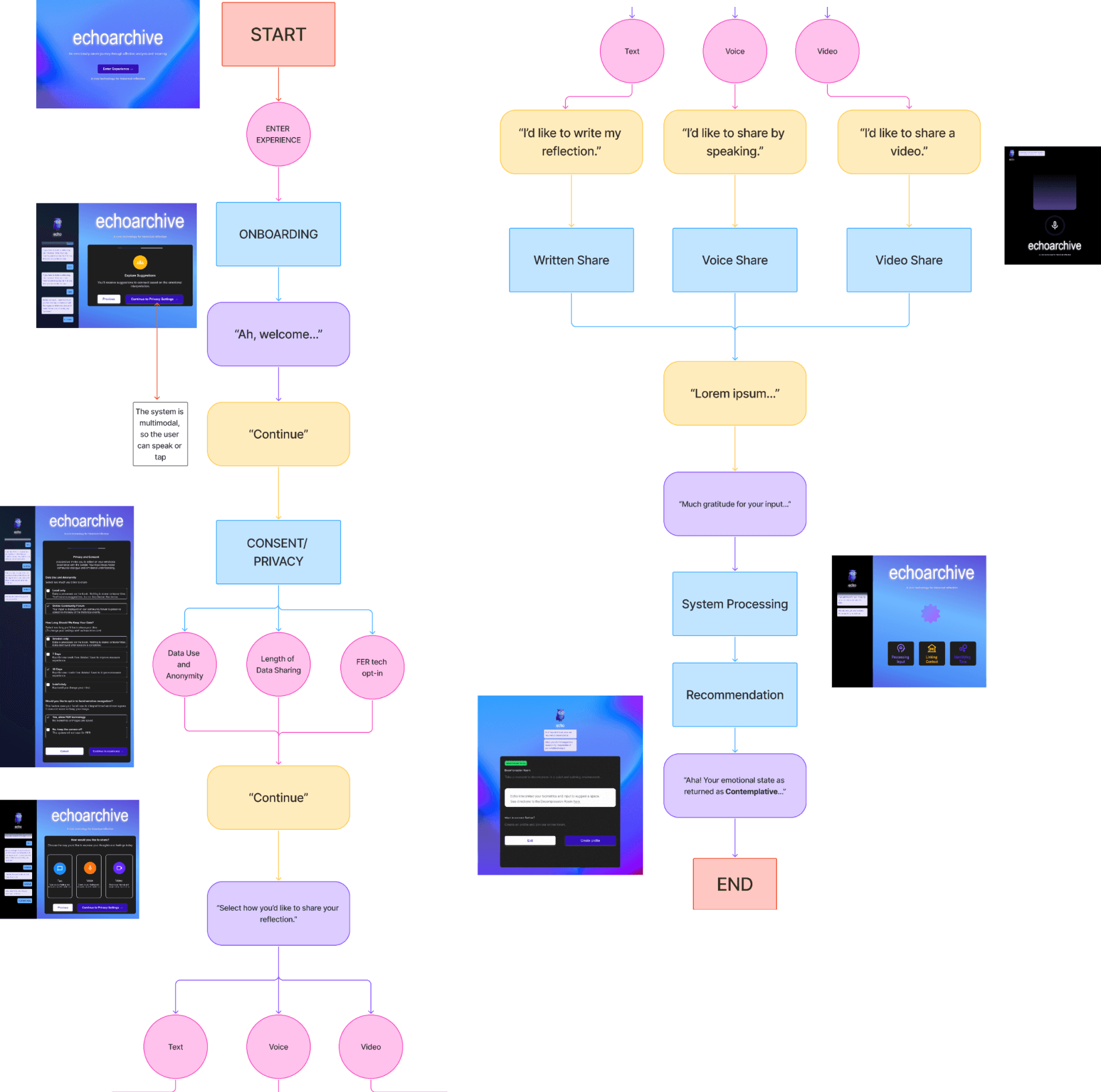
I laid out a primary conversation flow to visualize a user's journey.
Engineering & final prototype
How I built echoarchive
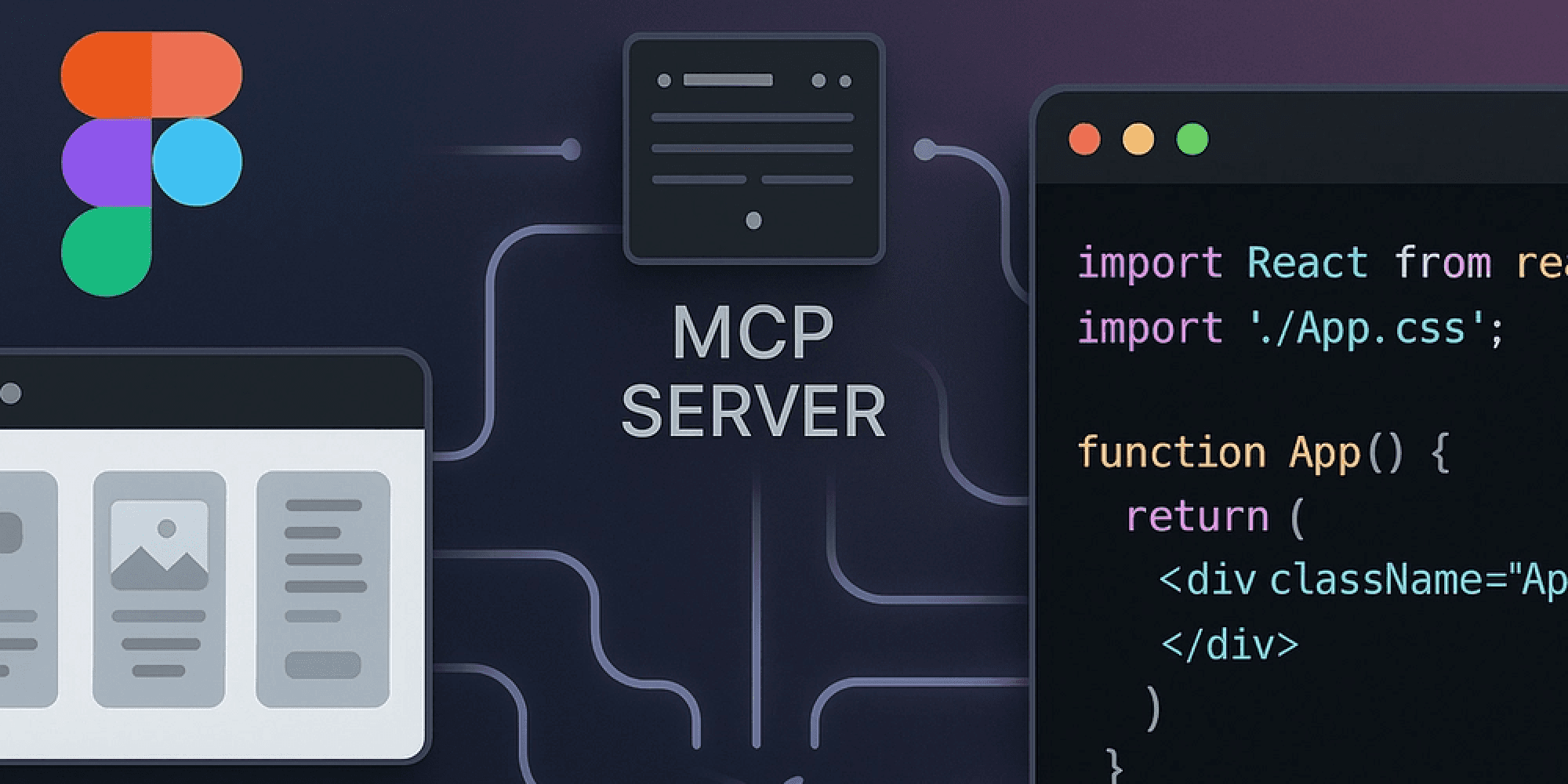
After designing final designs, I used Figma's MCP to Cursor to fully build out a functional website, complete with HTML, CSS, and Javascript, hosted on Github.
Try out the prototype!
echoarchive
An emotionally aware journey through affective analysis and meaning
Enter Experience →
A civic technology for historical reflection

echo
Ah, welcome.
I am Echo — curator of this archive. Not of objects, but of emotional memory.
When you feel prepared to proceed, say "begin."
Begin.
I shall guide you through the process. Say next when you're ready.
Next.
echoarchive
A civic technology for historical reflection
Share Your Feelings
You’ll be invited to share your feelings through text, voice, or video reflection
Next →
echo
Ah, welcome.
I am Echo — curator of this archive. Not of objects, but of emotional memory.
When you feel prepared to proceed, say "begin."
Begin.
I shall guide you through the process. Say next when you're ready.
Next.
If you need to revisit a prior step, say "previous." Otherwise, say "next" to continue. Say "exit" at any time you would like to stop.
Next.
echoarchive
A civic technology for historical reflection
I’ll Listen
My system will interpret what you decide to share.
Previous
Next →
echo
Ah, welcome.
I am Echo — curator of this archive. Not of objects, but of emotional memory.
When you feel prepared to proceed, say "begin."
Begin.
I shall guide you through the process. Say next when you're ready.
Next.
If you need to revisit a prior step, say "previous." Otherwise, say "next" to continue. Say "exit" at any time you would like to stop.
Next.
If you need to revisit a prior step, say "previous." Otherwise, say "next" to continue. Say "exit" at any time you would like to stop.
Next.
Before we begin, I want to ensure you feel entirely comfortable with the degree to which you choose to share. When you are ready, say "continue."
Continue.
echoarchive
A civic technology for historical reflection
Explore Suggestions
You’ll receive suggestions to connect based on the emotional interpretation.
Previous
Continue to Privacy Settings →
echo
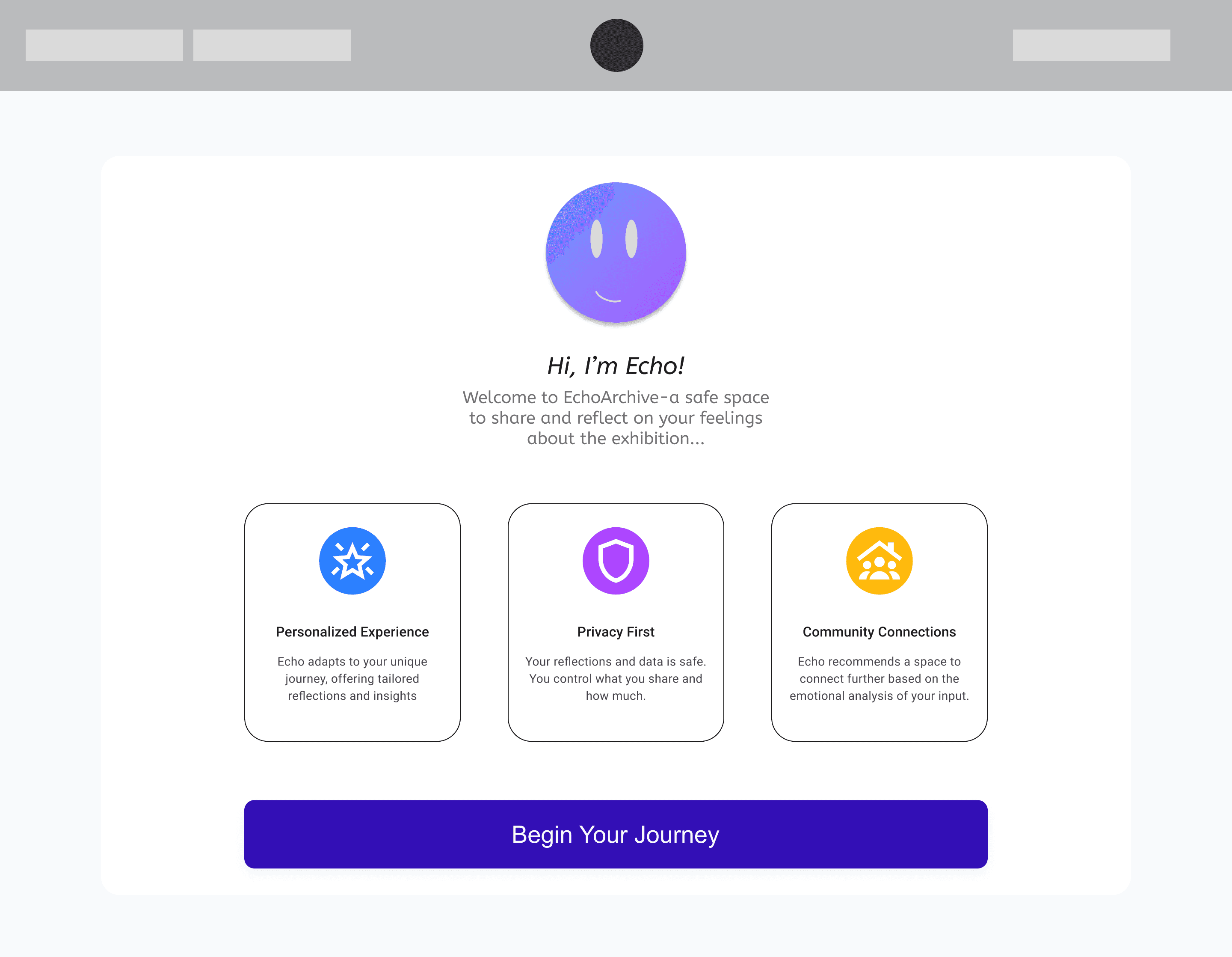
Hi, I’m Echo!
Welcome to EchoArchive - a safe space to share and reflect on your feelings about the exhibition
Tap the button or say “begin” to start.
Begin.
I shall guide you through the process. Say next when you're ready.
Next.
If you need to revisit a prior step, say "previous." Otherwise, say "next" to continue. Say "exit" at any time you would like to stop.
Continue.
Before we begin, I want to ensure you feel entirely comfortable with the degree to which you choose to share. When you are ready, say "continue."
Continue.
Just say the word when you are ready to proceed.
Continue.
echoarchive
A civic technology for historical reflection
Privacy and Consent
echoarchive invites you to reflect on your emotional experience with the exhibit. Your input helps foster community dialogue and emotional understanding.
Data Use and Anonymity
Select how much you’d like to share
Local only
Data is processed on the kiosk. Nothing is stored or transmitted. You’ll receive suggestions, but no data leaves the device.
Online Community Forum
Your input is displayed on our community forum to preserve collective memory of the historical events.
How Long Should We Keep Your Data?
Select how long you’d like to share your data
(To change your settings visit: echoarchive.com)
Session only
Data is processed on the kiosk. Nothing is stored or transmitted. Data destroyed after session is completed.
7 Days
Kept for one week then deleted. Used to improve museum experience
30 Days
Kept for one month then deleted. Used to improve museum experience
Indefinitely
Kept until you change your mind.
Would you like to opt in to facial‑emotion recognition?
This feature uses your facial cues to interpret broad emotional signals. It does not record or keep your image.
Yes, allow FER technology
No biometrics or images are saved.
No, keep the camera off
The system will not scan for FER
Cancel
Continue to experience →
echo
Hi, I’m Echo!
Welcome to EchoArchive - a safe space to share and reflect on your feelings about the exhibition
Tap the button or say “begin” to start.
Begin.
I shall guide you through the process. Say next when you're ready.
Next.
If you need to revisit a prior step, say "previous." Otherwise, say "next" to continue. Say "exit" at any time you would like to stop.
Next.
Before we begin, I want to ensure you feel entirely comfortable with the degree to which you choose to share. When you are ready, say "continue."
Continue.
Just say the word when you are ready to proceed.
Continue.
Now, select how you'd like to share your reflection.
I’ll share a video.
echoarchive
A civic technology for historical reflection
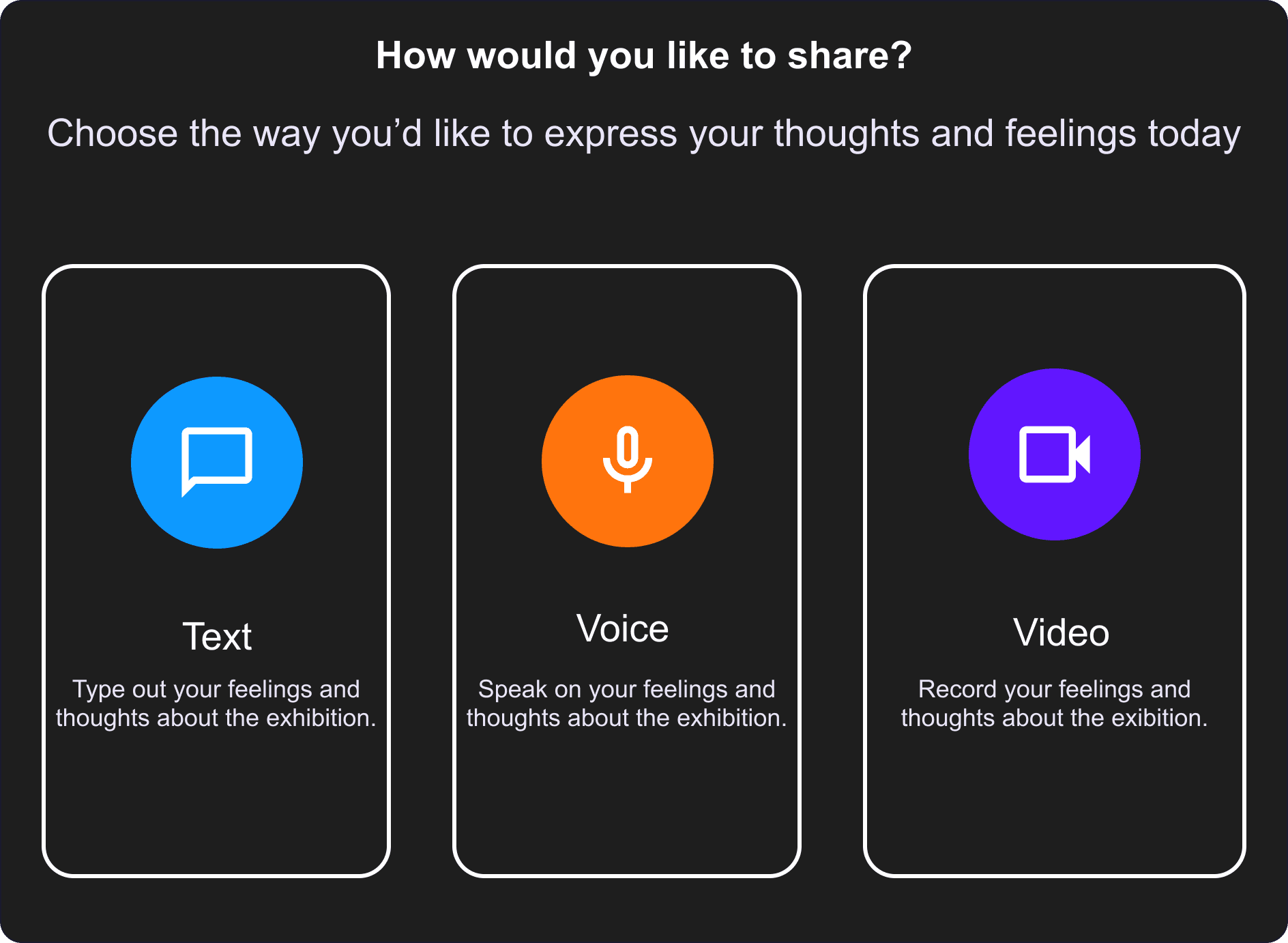
How would you like to share?
Choose the way you’d like to express your thoughts and feelings today
Text
Type out your feelings and thoughts about the exhibition.
Voice
Speak on your feelings and thoughts about the exhibition.
Video
Record your feelings and thoughts about the exibition.
Previous
Continue to Privacy Settings →
echo
echoarchive
A civic technology for historical reflection
Excellent choice! Allow yourself to freely express what lies at the center of your heart and mind.
echo
Hi, I’m Echo!
Welcome to EchoArchive - a safe space to share and reflect on your feelings about the exhibition
Tap the button or say “begin” to start.
Begin.
I’ll guide you through the process. Say next when you’re ready.
Next.
If you need to go back, say “previous.” Otherwise say “next” to continue.
Next.
The last step is to make sure you’re comfortable with sharing however much you want
Just say the word when you are ready to proceed.
I’ll share via voice.
Much gratitude for your input. My system is now processing the data.
This will take just one moment. Thank you for your patience.
echoarchive
A civic technology for historical reflection
Processing Input
Linking Context
Identifying Tone
echo
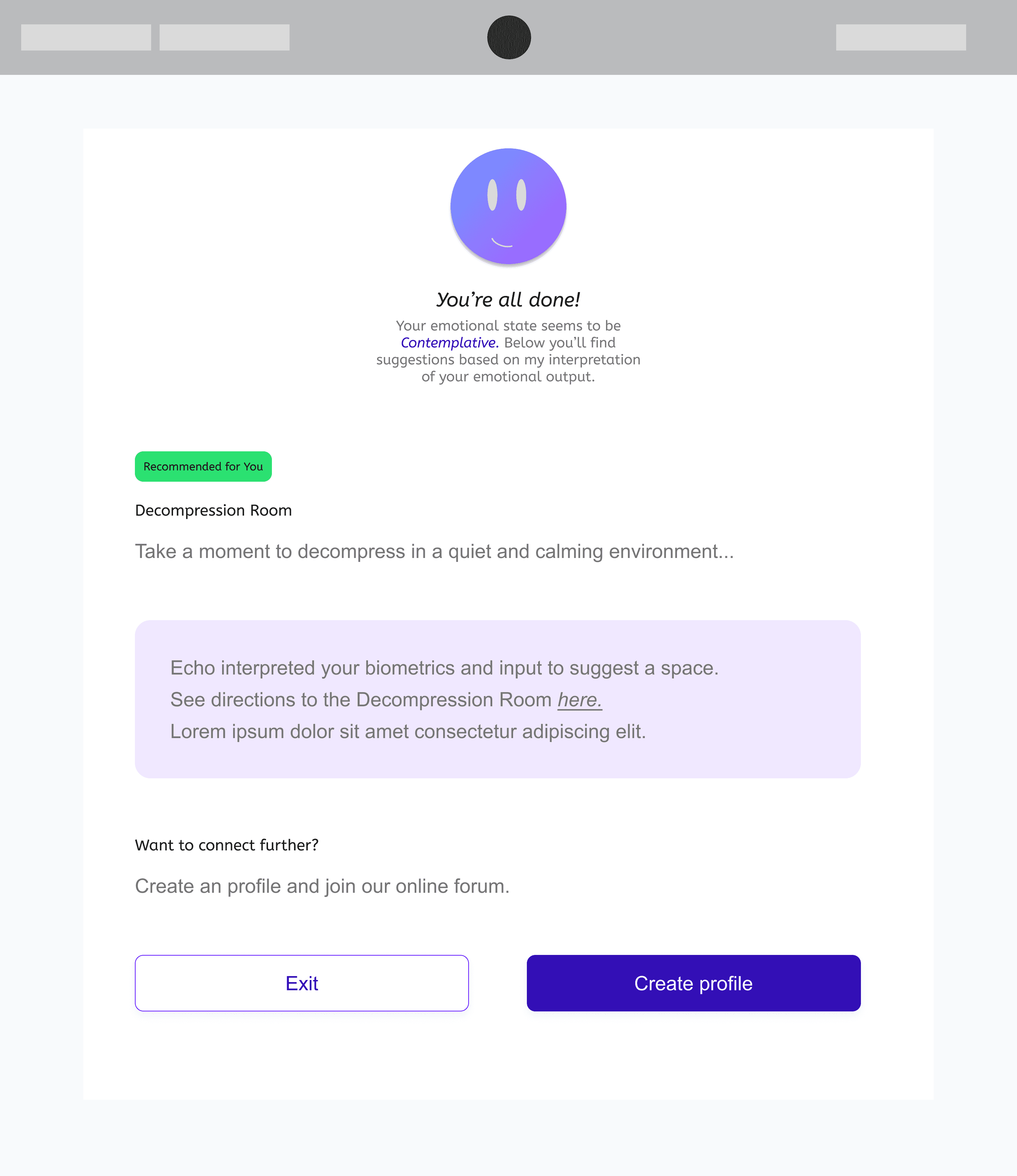
Aha! Your emotional state has returned as Contemplative.
Below you will find suggestions based on my interpretation of your emotional output.
Recommended for You
Decompression Room
Take a moment to decompress in a quiet and calming environment...
Echo interpreted your biometrics and input to suggest a space.
See directions to the Decompression Room here.
Want to connect further?
Create an profile and join our online forum.
Exit
Create profile
Reflection
My takeaways
Future implications:
Real-world deployment in museums or civic forums
Participation in the forum can end up as a historical online document (what exists online challenges narrative erasure)
Challenges and Tensions:
Emotional exposure in a public kiosk: A museum floor is not a therapy room. The design had to balance genuine emotional safety with the reality that users are surrounded by strangers
Conversational Design: Overall, navigating the power dynamics of a conversational bot, especially one like this, can be challenging when considering ethical ux for the user.
Major learnings:
Emotional systems must empower users to define emotions themselves